
Category

Dye Type

Langeron’s Alum Hematoxylin Variants

By Dye Type, Hematoxylin and Eosin Staining, Mordanted Hematoxylin, Protocols, Stain Type

Langeron's Alum Hematoxylin Variants

8
steps
9
materials

Both of Langeron’s formulae are modifications of Mayer’s formulae. Langeron’s 1924 formula is a modification of Mayer’s 1896 formula, and Langeron’s 1942 formula is a modification of Mayer’s 1901 formula.

Langeron’s 1942 formula is the solution usually meant when Mayer’s hemalum is specified.

Materials

MaterialSolutionFunction
19241942
Hematoxylin4 g1 gDye
Ammonium alum50 gMordant
Potassium alum50 gMordant
Distilled water700 mL1 LSolvent
Glycerol300 mLStabilizer
Sodium iodate0.2 gOxidant
Glacial acetic acid20 mLAcidifier
Citric acid1 gAcidifier
Chloral hydrate50 gAcidifier

Compounding Procedures

1924

  1. Grind the hematoxylin with glycerol in a pestle and mortar.
  2. Dissolve the other ingredients in water.
  3. Add the hematoxylin paste.
  4. Wash out the hematoxylin paste with the solution.
  5. Leave months to ripen.

1942

  1. Dissolve the Alum and dye in the water.
  2. Add the other ingredients.
  3. Bring to the boil.
  4. Cool to room temperature.
  5. The solution may be used immediately.
  6. Ammonium Alum may be substituted for potassium alum.

Protocol

  1. Bring sections to water with xylene and ethanol.
  2. Place into the staining solution for an appropriate time.
  3. Rinse well with water.
  4. Differentiate the 1924 solution with acid ethanol if necessary.
  5. Rinse with water and blue.
  6. Rinse well with water.
  7. Counterstain if desired.
  8. Dehydrate with ethanol, clear with xylene and mount with a resinous medium.

Expected Results

  • Nuclei  –  blue
  • Background  –  as counterstain or unstained

Notes

  • The 1924 solution is regressive, and staining time should be determined by trial.
  • The 1942 solution is progressive. Staining time is 5-10 minutes.
  • Acid ethanol is 0.5% – 1% hydrochloric acid in 70% ethanol.
  • Blueing is done with alkaline solutions such as hard tap water, Scott’s tap water substitute, 0.1% ammonia water, 1% aqueous sodium acetate, 0.5% aqueous lithium carbonate etc.

Safety Note

Prior to handling any chemical, consult the Safety Data Sheet (SDS) for proper handling and safety precautions.

References

  1. Gray, Peter. (1954)
    The Microtomist’s Formulary and Guide.
    Originally published by: The Blakiston Co.
    Republished by: Robert E. Krieger Publishing Co.
Launoy’s Alum Hematoxylin

By Dye Type, Hematoxylin and Eosin Staining, Mordanted Hematoxylin, Protocols, Stain Type

Launoy's Alum Hematoxylin

8
steps
3
materials

Materials

MaterialAmountFunction
Hematein10 gDye
Potassium alum5 gMordant
Distilled water1 LSolvent

Compounding Procedure

  1. Combine all ingredients, and dissolve.
  2. The solution may be used immediately.

Protocol

  1. Bring sections to water with xylene and ethanol.
  2. Place into the staining solution for an appropriate time.
  3. Rinse well with water.
  4. Differentiate with acid ethanol if necessary.
  5. Rinse with water and blue.
  6. Rinse well with water.
  7. Counterstain if desired.
  8. Dehydrate with ethanol, clear with xylene and mount with a resinous medium.

Expected Results

  • Nuclei  –  blue
  • Background  –  as counterstain or unstained

Notes

  • This solution uses hematein instead of hematoxylin.
  • Although the staining characteristics are not given, the high dye and low Alum content would indicate it is likely a strong, regressive solution.
  • The staining time should be determined by trial.
  • Acid ethanol is 0.5% – 1% hydrochloric acid in 70% ethanol.
  • Blueing is done with alkaline solutions such as hard tap water, Scott’s tap water substitute, 0.1% ammonia water, 1% aqueous sodium acetate, 0.5% aqueous lithium carbonate etc.

Safety Note

Prior to handling any chemical, consult the Safety Data Sheet (SDS) for proper handling and safety precautions.

References

  1. Gray, Peter. (1954)
    The Microtomist’s Formulary and Guide.
    Originally published by: The Blakiston Co.
    Republished by: Robert E. Krieger Publishing Co.
Lee’s Alum Hematoxylin

By Dye Type, Hematoxylin and Eosin Staining, Mordanted Hematoxylin, Protocols, Stain Type

Lee's Alum Hematoxylin

6
steps
5
materials

Materials

MaterialAmountFunction
Hematoxylin1 gDye
Ammonium alum50 gMordant
Distilled water1 LSolvent
Chloral hydrate50 gStabiliser
Sodium iodate0.2 gOxidant

Compounding Procedure

  1. Combine all the ingredients.
  2. Bring to a boil.
  3. Cool and filter.
  4. The solution may be used immediately.

Protocol

  1. Bring sections to water with xylene and ethanol.
  2. Place into the staining solution for 5-10 minutes.
  3. Rinse with water and blue.
  4. Rinse well with water.
  5. Counterstain if desired.
  6. Dehydrate with ethanol, clear with xylene and mount with a resinous medium.

Expected Results

  • Nuclei  –  blue
  • Background  –  as counterstain or unstained

Notes

  • The solution is similar to Mayer’s hemalum and should have much of the same characteristics.
  • Blueing is done with alkaline solutions such as hard tap water, Scott’s tap water substitute, 0.1% ammonia water, 1% aqueous sodium acetate, 0.5% aqueous lithium carbonate etc.

Safety Note

Prior to handling any chemical, consult the Safety Data Sheet (SDS) for proper handling and safety precautions.

References

  1. Gray, Peter. (1954)
    The Microtomist’s Formulary and Guide.
    Originally published by: The Blakiston Co.
    Republished by: Robert E. Krieger Publishing Co.
Lillie’s Alum Hematoxylin

By Dye Type, Hematoxylin and Eosin Staining, Mordanted Hematoxylin, Protocols, Stain Type

Lillie's Alum Hematoxylin

8
steps
6
materials

Materials

MaterialAmountFunction
Hematoxylin5 gDye
Ammonium alum50 gMordant
Distilled water700 mLSolvent
Glycerol300 mLStabilizer
Sodium iodate0.5 gOxidant
Glacial acetic acid20 mLAcidifier

Compounding Procedure

  1. Dissolve the dye and Alum in the water.
  2. Add the iodate, glycerol and acid.
  3. Leave overnight to ripen before using.

Protocol

  1. Bring sections to water with xylene and ethanol.
  2. Place into the staining solution for 5 minutes.
  3. Rinse well with water.
  4. Differentiate with acid ethanol if necessary.
  5. Rinse with water and blue.
  6. Rinse well with water.
  7. Counterstain if desired.
  8. Dehydrate with ethanol, clear with xylene and mount with a resinous medium.

Expected Results

  • Nuclei  –  blue
  • Background  –  as counterstain or unstained

Notes

  • This is a strong, regressive solution.
  • The staining time should be determined by trial.
  • Acid ethanol is 0.5% – 1% hydrochloric acid in 70% ethanol.
  • Blueing is done with alkaline solutions such as hard tap water, Scott’s tap water substitute, 0.1% ammonia water, 1% aqueous sodium acetate, 0.5% aqueous lithium carbonate etc.

Safety Note

Prior to handling any chemical, consult the Safety Data Sheet (SDS) for proper handling and safety precautions.

References

  1. Lillie, R.D.,
    Histopathologic Technic and Practical Histochemistry
    McGraw-Hill, New York, USA

Lillie & Earle’s Iron Hematoxylin

By Dye Type, Hematoxylin and Eosin Staining, Mordanted Hematoxylin, Protocols, Stain Type

Lillie & Earle's Iron Hematoxylin

8
steps
6
materials

Materials

Solution A

MaterialAmountFunction
Hematoxylin1 gDye
95% ethanol50 mLSolvent
Glycerol50 mLSolvent

Solution B

MaterialAmountFunction
Ferric ammonium sulfate15 gMordant
Ferrous sulfate15 gMordant
Distilled water100 mLSolvent

Compounding Procedure

  1. Make each solution separately.
  2. For use, combine equal parts of solutions A and B.
  3. The working solution may be used immediately.

Protocol

  1. Bring sections to water with xylene and ethanol.
  2. Place into the staining solution for an appropriate time.
  3. Rinse with tap water.
  4. If overstained, dip briefly in 1% hydrochloric acid in 70% ethanol.
  5. Wash well in running tap water to blue.
  6. Rinse with distilled water.
  7. Counterstain if desired.
  8. Dehydrate with ethanol, clear with xylene and mount with a resinous medium.

Expected Results

  • Nuclei  –  black
  • Background  –  as counterstain or unstained

Notes

  • The stock solutions are stable for some time.
  • The life of the working solution is not given. It is likely not stable for long, although the inclusion of glycerol and ferrous sulfate may improve its stability.
  • The staining time should be determined by trial, but 10-30 minutes should suffice.

Safety Note

Prior to handling any chemical, consult the Safety Data Sheet (SDS) for proper handling and safety precautions.

References

  1. Gray, Peter. (1954)
    The Microtomist’s Formulary and Guide.
    Originally published by: The Blakiston Co.
    Republished by: Robert E. Krieger Publishing Co.
    Citing:
    Lillie and Earle, (1937).
    American Journal of Pathology, v. 15, p. 765.

Lillie’s Iron Hematoxylin

By Dye Type, Hematoxylin and Eosin Staining, Mordanted Hematoxylin, Protocols, Stain Type

Lillie's Iron Hematoxylin

6
steps
6
materials

Materials

MaterialVariantFunction
19401954
Hematoxylin1 g0.5 gDye
Ferric chloride1.2 g1.2 gMordant
Ferrous sulfate4.44 gMordant
100% ethanol100 mLSolvent
Distilled water100 mL292 mLSolvent
Hydrochloric acid1 mL8 mLSolvent

Compounding Procedures

1940

    1. Dissolve the ferric chloride in half of the water.
    2. Dissolve the hematoxylin in the other half.

Combine and add the hydrochloric acid.

1954

  1. Dissolve the hematoxylin in the ethanol.
  2. Dissolve the ferric chloride and ferrous sulfate in the water.
  3. Add the hydrochloric acid.
  4. Combine the solutions.

Protocol

  1. Bring sections to water with xylene and ethanol.
  2. Place into the staining solution for 5-30 minutes.
  3. Wash well in running tap water to blue.
  4. Rinse with distilled water.
  5. Counterstain if desired.
  6. Dehydrate with ethanol, clear with xylene and mount with a resinous medium.

Expected Results

  • Nuclei  –  black
  • Background  –  as counterstain or unstained

Notes

  • The 1940 formula is likely not stable for long. If staining is too dark, dip briefly in 1% hydrochloric acid in 70% ethanol.
  • The 1954 formula is a modification of Wiegert’s iron hematoxylin. Lillie states that it is stable for several weeks with occasional use. It is progressive, and does not require differentiation.

Safety Note

Prior to handling any chemical, consult the Safety Data Sheet (SDS) for proper handling and safety precautions.

References

  1. Lillie, R.D., (1954)
    Histopathologic technique and practical histochemistry Ed.2
    Blakiston, New York, USA.
  2. Gray, Peter. (1954)
    The Microtomist’s Formulary and Guide.
    Originally published by: The Blakiston Co.
    Republished by: Robert E. Krieger Publishing Co.

    Citing:
    Lillie, (1940)
    Archiv für pathologische Anatomie,
    v. 29, p. 705.

Lugol’s Alum Hematoxylin

By Dye Type, Hematoxylin and Eosin Staining, Mordanted Hematoxylin, Protocols, Stain Type

Lugol’s Alum Hematoxylin

6
steps
6
materials

Materials

Lugol’s Iodide

MaterialAmountFunction
Iodine2 gOxidant
Potassium iodide4 g
Distilled water100 mLSolvent

Hematoxylin

MaterialAmountFunction
95% ethanol100 mLSolvent
Hematoxylin10 gDye

Alum

MaterialAmountFunction
Potassium alum6 gMordant
Distilled water500 mLSolvent

Working solution

MaterialAmount
Hematoxylin1.5 mL
Lugol’s iodine1.5 mL
Alum100 mL

Compounding Procedure

  1. Make each solution as listed.
  2. Combine as directed above.
  3. Leave for 15 minutes before use.

Protocol

  1. Bring sections to distilled water with xylene and ethanol.
  2. Place into the staining solution for 5-10 minutes.
  3. Rinse with water and blue.
  4. Rinse well with water.
  5. Counterstain if desired.
  6. Dehydrate with ethanol, clear with xylene and mount with a resinous medium.

Expected Results

  • Nuclei  –  blue
  • Background  –  as counterstain or unstained

Notes

  • Read these comments on Lugol’s iodine.
  • The solution is usable for a minimum of one week.
  • The working solution will stain at least 100 slides.
  • Since the solution is not acidified, a distilled water rinse before staining will reduce alkaline carry over.
  • The authors named this solution Lugol’s Hematoxylin.
  • Blueing is done with alkaline solutions such as hard tap water, Scott’s tap water substitute, 0.1% ammonia water, 1% aqueous sodium acetate, 0.5% aqueous lithium carbonate etc.

Safety Note

Prior to handling any chemical, consult the Safety Data Sheet (SDS) for proper handling and safety precautions.

References

  1. Clarke, G. and Dodds, H. M., (1983)
    Lugol’s Hematoxylin.
    Stain Technology, v 58, Nº 4, p. 232

McLachlan’s Alum Hematoxylin

By Dye Type, Hematoxylin and Eosin Staining, Mordanted Hematoxylin, Protocols, Stain Type

McLachlan's Alum Hematoxylin

6
steps
7
materials

This formulation has been named in honor of Dr. H.K.I. McLachlan FRCPA at the request of the originator, Mike Rentsch.

Materials

MaterialVariantFunction
Var IVar II
Hematoxylin2 g2 gDye
Aluminum sulphate17.5 gMordant
Ammonium alum25 gMordant
Distilled water700 mL700 mLSolvent
Glycerol300 mL300 mLStabiliser
Sodium iodate0.2 g0.2 gOxidant
Glacial acetic acid20 mL20 mLAcidifier

Compounding Procedure

  1. Dissolve the aluminum sulphate or the Alum in about 500 mL water.
  2. Add the hematoxylin and dissolve.
  3. Add the acetic acid and mix well.
  4. Warm the glycerol to reduce viscosity, and add to the mixture.
  5. Mix well, then make up to 1 litre with water.
  6. Add the iodate and mix for 5-10 minutes.
  7. Store in a tightly capped bottle in the dark.
  8. The solution remains usable for 2-5 years.

Protocol

  1. Bring sections to water with xylene and ethanol.
  2. Place paraffin sections in the staining solution for 2-4 minutes and frozen sections for 40-60 seconds.
  3. Rinse with water and blue.
  4. Rinse well with water.
  5. Counterstain if desired.
  6. Dehydrate with ethanol, clear with xylene and mount with a resinous medium.

Expected Results

  • Nuclei  –  blue
  • Background  –  as counterstain or unstained

Notes

  • This is a progressive solution.
  • Blueing is done with alkaline solutions such as hard tap water, Scott’s tap water substitute, 0.1% ammonia water, 1% aqueous sodium acetate, 0.5% aqueous lithium carbonate etc.

Safety Note

Prior to handling any chemical, consult the Safety Data Sheet (SDS) for proper handling and safety precautions.

References

  1. Rentsch, M.
    Australian Biostain P/L.
    Personal communication via the internet.

Lendrum & Mcfarlane Iron Alum-Celestine Blue for Nuclei

By Dye Type, Hematoxylin Alternatives, Protocols, Stain Type

Lendrum & Mcfarlane Iron Alum-Celestine Blue

for Nuclei

6
steps
5
materials

Materials

  • An eosin solution, or other counterstain
  • Iron alum-celestine blue
    MaterialAmount
    Ferric ammonium sulfate5g
    Celestine blue B0.5g
    Distilled water100mL
    Glycerol14mL

Preparation

  1. Dissolve the ferric ammonium sulfate in the distilled water.
  2. Add the celestine blue B.
  3. Boil for 5 minutes.
  4. Cool and filter.
  5. Add the glycerol.

Tissue Sample

5µ paraffin sections of neutral buffered formalin fixed tissue are suitable. Other fixatives are likely to be satisfactory.

Protocol

  1. Bring sections to water via xylene and ethanol.
  2. Place into the iron alum-celestine blue solution for 3 minutes to 2 hours.
  3. Wash with tap water.
  4. Counterstain with eosin or other counterstain.
  5. Dehydrate with 95% and absolute ethanols.
  6. Clear with xylene and mount with a resinous medium.

Expected Results

  • Nuclei  –  blue
  • Cytoplasm  –  pink

Notes

  • The iron alum-celestine blue solution is stable for a few months.
  • A staining time of 5-10 minutes is usually satisfactory for formalin fixed tissues.
  • This method has been recommended as a substitute for Hematoxylin and Eosin.
  • The celestine blue solution is a modification of that recommended by Proescher and Arkush, and contains added glycerol.
  • Gallamine blue and gallocyanin have also been recommended in this method. Neither dye is as stable as celestine blue, although the colour with gallocyanin most closely resembles alum hematoxylin of all three dyes.

Safety Note

Prior to handling any chemical, consult the Safety Data Sheet (SDS) for proper handling and safety precautions.

References

  1. Gray, Peter. (1954)
    The Microtomist’s Formulary and Guide.
    Originally published by: The Blakiston Co.
    Republished by: Robert E. Krieger Publishing Co.

    Citing:
    Lendrum and McFarlane, (1940)
    Journal of Pathology and Bacteriology, v. 50, pp. 381

Llewellyn’s Mordant Blue 3 for Nuclei

By Dye Type, Hematoxylin Alternatives, Protocols, Stain Type

Llewellyn's Mordant Blue 3

for Nuclei

9
steps
8
materials

This is a substitute for alum hematoxylin in the H&E stain.

Materials

  • An aqueous or alcoholic eosin Y solution
  • Solution A
    MaterialVariant
    19741978a1978b
    Mordant blue 30.25g1g1g
    Iron alum, 10% aqu.40mL90mL5mL
    Sulphuric acid5mL
    Hydrochloric acid10mL
    Acetic acid50mL
    Distilled water955mL860mL985mL

    For all variants:

    1. Dilute the iron alum with the water.
    2. Add the mordant blue 3 and dissolve.
    3. Add the specified acid, mix and filter.

    The solutions are usable immediately and they have a shelf life of more than one year.

  • Solution B
    MaterialVariant
    Var AVar B
    Hydrochloric acid, conc1mL1mL
    Ethanol, 70%99mL
    Distilled water99mL
  • Solution C
    MaterialAmount
    Sodium acetate0.5g
    Distilled water100mL

Tissue Sample

5 µ paraffin sections of neutral buffered formalin fixed tissue are suitable. Other fixatives are likely to be satisfactory.

Protocol

  1. Bring sections to water via xylene and ethanol.
  2. Place into solution A for 5 minutes.
  3. Rinse well with tap water.
  4. Differentiate with a variant of solution B:
    1. For the 1974 formula: var A for 1-3 seconds or var B for 30 seconds.
    2. For the 1978a formula: var A for about ten seconds.
    3. For the 1978b formula: do not differentiate. Proceed to step 6.
  5. Rinse well with tap water.
  6. Blue with solution C for about 30 seconds.
  7. Rinse well with tap water.
  8. Counterstain with an eosin solution.
  9. Dehydrate with ethanol, clear with xylene and mount with a resinous medium.

Expected Results

  • Nuclei  –  blue
  • Cytoplasm  –  shades of pink

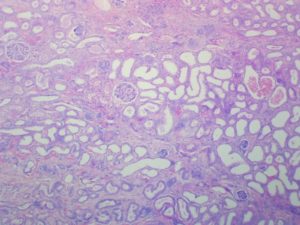
Human kidney stained progressively with mordant blue 3 and eosin Y at 40x magnification

Human kidney stained progressively with mordant blue 3 and eosin Y at 40x magnification

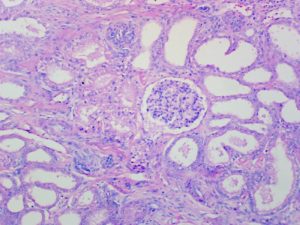
Human kidney stained progressively with mordant blue 3 and eosin Y at 100x magnification

Human kidney stained progressively with mordant blue 3 and eosin Y at 100x magnification

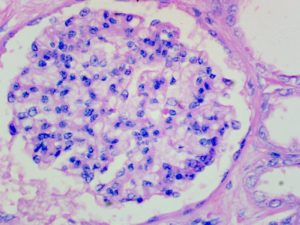
Human kidney stained progressively with mordant blue 3 and eosin Y at 400x magnification

Human kidney stained progressively with mordant blue 3 and eosin Y at 400x magnification

Notes

  • At times hematoxylin powder has become difficult, if not impossible, to buy. Due to the importance of this dye in making alum hematoxylin for H&E stains, several other dyes were investigated as substitutes. Mordant blue 3 was one of these, and Llewellyn published three variants of this substitute, both progressive and regressive.
  • The 1974 and 1978a formulae are regressive. The 1978b formula is progressive.
  • The sections will be blue after solution A. The blueing referred to in step 6 will deepen this, but it’s main purpose is to remove any pink staining due to unmordanted dye.
  • Iron alum is ferric ammonium sulphate:  FeNH4(SO4)2·12H2O. Use clean crystals.

Safety Note

Prior to handling any chemical, consult the Safety Data Sheet (SDS) for proper handling and safety precautions.

References

  1. Llewellyn, B. D., 1974
    Mordant blue3: A readily available substitute for hematoxylin
    in the routine hematoxylin and eosin stain.
    Stain Technology, v. 49, pp. 347.
  2. Llewellyn, B. D., 1978
    Improved nuclear staining with mordant blue 3 as a hematoxylin substitute
    Stain Technology, v. 53, pp. 73.