Category

Schiff’s Reagent Reactions

Periodic Acid Schiff Reaction

By Aldehydes, Periodic Acid-Schiff Reaction, Protocols, Schiff's Reagent Reactions, Stain Target, Stain Type

Periodic Acid Schiff Reaction

10
steps
3
materials

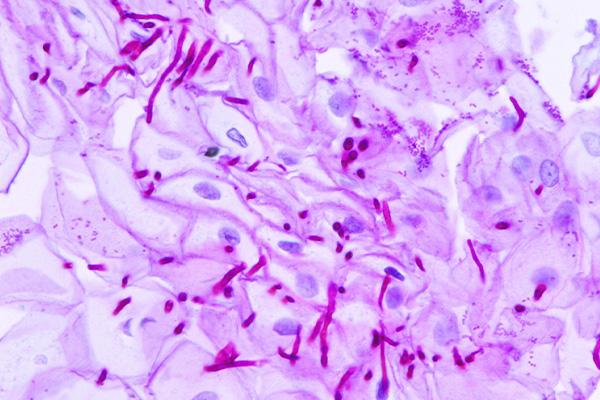
The periodic acid Schiff reaction (PAS) is used to demonstrate the presence of 1-2-glycols, and is consequently an important method in the histochemistry of carbohydrates and the histological demonstration of many structures.

Expected Results
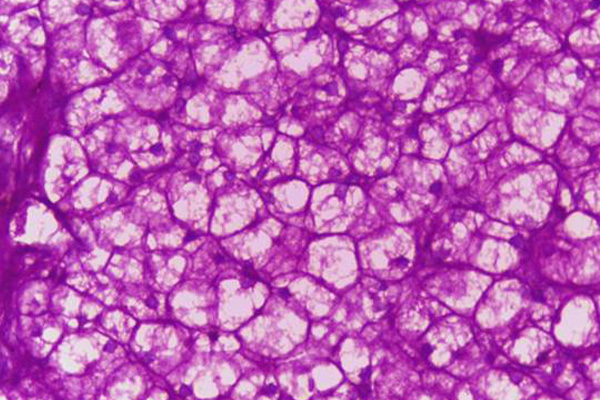
  • 1-2-glycols  –  red or dark purple
  • Nuclei  –  blue

Materials

Tissue Sample

5µ paraffin sections of neutral buffered formalin fixed tissue are suitable. Other fixatives are usually satisfactory, although glutaraldehyde should be avoided.

Protocol

  1. Bring sections to water via xylene and ethanol.
  2. Place into periodic acid for 10-30 minutes.
  3. Rinse well with tap water.
  4. Rinse with distilled water.
  5. Place in Schiff’s reagent for 10-30 minutes.
  6. Wash off with distilled water.
  7. Wash well with tap water for about 10 minutes.
  8. Counterstain with Mayer’s hemalum for 2 minutes.
  9. Wash well with tap water until hemalum is blued.
  10. Dehydrate with ethanol, clear with xylene and coverslip using a resinous medium.

Notes

  • Glutaraldehyde fixation leaves free aldehyde groups attached to tissues, which causes an overall positive reaction. These groups may be stopped from reacting with an appropriate procedure such as the aniline-acetic aldehyde block.
  • The tap water wash at step 7 is necessary to develop the red color. Within limits, the longer the wash the darker the color.
  • Originally, it was recommended that the Schiff’s reagent be washed off with dilute sulfurous acid (the sulfite rinses). Since water recolors Schiff’s reagent, it was believed that a water wash could lead to false positive results. It is now known this is not the case, provided the Schiff’s reagent is removed quickly and the sections do not stay in water contaminated with it for extended periods.

Safety Note

Prior to handling any chemical, consult the Safety Data Sheet (SDS) for proper handling and safety precautions.

References

  1. Culling C.F.A., (1974)
    Handbook of histopathological and histochemical techniques Ed. 3
    Butterworth, London, UK.

Bauer Reaction for Carbohydrates

By Aldehydes, Chromic Acid-Schiff Reaction, Protocols, Schiff's Reagent Reactions, Stain Target, Stain Type

Bauer Reaction

for Carbohydrates

9
steps
7
materials

Materials

  • A Schiff reagent
  • A progressive hemalum, such as Mayer
  • Chromic acid
    MaterialAmount
    Chromium trioxide4g
    Distilled water100mL
  • Sulfurous acid
    MaterialAmount
    Sodium metabisulfite, 10% aqu.6mL
    Hydrochloric acid, 1N5mL
    Distilled water100mL

Tissue Sample

5µ paraffin sections of neutral buffered formalin fixed tissue are suitable. Other fixatives are likely to be satisfactory. Most trichrome stains benefit from picric acid or mercuric chloride fixation. Formalin fixed tissues may benefit from secondary fixation of sections in Bouin’s fluid.

Protocol

  1. Bring sections to water via xylene and ethanol.
  2. Oxidize in chromic acid for 40-60 minutes.
  3. Rinse with tap, then distilled water.
  4. Place into Schiff’s reagent for 15 minutes.
  5. Place into sulfurous acid rinses, 3 changes of 2 minutes each.
  6. Wash with running tap water.
  7. Counterstain with hemalum for 1 minute, and blue
  8. Dehydrate with ethanols.
  9. Clear with xylene and mount with a resinous medium.

Expected Results

  • Glycogen, mucin  –  red
  • Fungi  –  red
  • Nuclei  –  blue

Notes

  • Modern practice is to leave out the sulfite rinses and wash with large amounts of tap water.
  • A progressive hemalum should be used as counterstain because regressive hemalums sometimes stain mucin.
  • Mucins are not usually as dark as with a PAS.
  • Applying chromic acid for too long weakens staining due to continued oxidation of the aldehydes first produced.

Safety Note

Prior to handling any chemical, consult the Safety Data Sheet (SDS) for proper handling and safety precautions.

References

  1. McManus, J. F. A. and Mowry, R. W., (1960)
    Staining Methods Histologic and Histochemical
    Harper & Row, New York, NY, USA.

Lillie’s Allochrome

By Periodic Acid-Schiff Reaction, Protocols, Schiff's Reagent Reactions, Stain Type
Protocol

Lillie's Allochrome

8
steps
5
materials

Materials

  • 1% Aqueous periodic acid
  • Schiff’s reagent
  • Weigert’s iron hematoxylin
  • Picro-methyl blue
    MaterialAmount
    Saturated aqueous picric acid100mL
    1% aqueous methyl blue0.4mL

Tissue Sample

5 µ paraffin sections. Most fixatives are satisfactory, including 10% NBF, but those generally considered preferable for trichrome stains will be advantageous.

Protocol

  1. Bring sections to water via xylene and ethanol.
  2. Do a PAS stain, but do not counterstain.
  3. Stain nuclei with Weigert’s iron hematoxylin or equivalent.
  4. Wash well in tap water, rinse with distilled water.
  5. Place into picro-methyl blue for 6 minutes.
  6. Rinse well with 95% ethanol.
  7. Dehydrate with absolute ethanol.
  8. Clear with xylene and mount with a resinous medium.

Expected Results

  • Nuclei – Brown-black
  • Collagen & reticulin – blue
  • Cytoplasm & muscle – yellow
  • PAS positive structures – red

Safety Note

Prior to handling any chemical, consult the Safety Data Sheet (SDS) for proper handling and safety precautions.

References

  1. Histological demonstration techniques, (1974)
    Cook, H C.
    Butterworths, London, England

Fluorescent Schiff

By Aldehydes, Chromic Acid-Schiff Reaction, Protocols, Schiff's Reagent Reactions, Stain Target, Stain Type

Fluorescent Schiff

11
steps
7
materials

This method demonstrates fungi, and may also be called a Fluorescent Gridley or CAFS.

Materials

  • Fluorescent Schiff reagent
  • Solution A
    MaterialAmount
    Chromium trioxide50g
    Distilled water500mL
  • Solution B
    MaterialAmount
    Sodium sulfite5g
    Distilled water500mL
  • Solution C
    MaterialAmount
    Ethanol, 70%495mL
    Hydrochloric acid5mL

Tissue Sample

5µ paraffin sections of neutral buffered formalin fixed tissue are suitable. Other fixatives are likely to be satisfactory.

Protocol

  1. Bring sections to water via xylene and ethanol.
  2. Place in solution A for 10 minutes.
  3. Wash well with tap water.
  4. Bleach with solution B for 1 minute.
  5. Wash well with tap water.
  6. Rinse with distilled water.
  7. Place in fluorescent Schiff reagent for 20 minutes.
  8. Wash well with tap water.
  9. Place in solution C, two changes, 5 minutes each.
  10. Wash well with tap water.
  11. Dehydrate, clear and mount in a non fluorescent resinous medium.

Expected Results

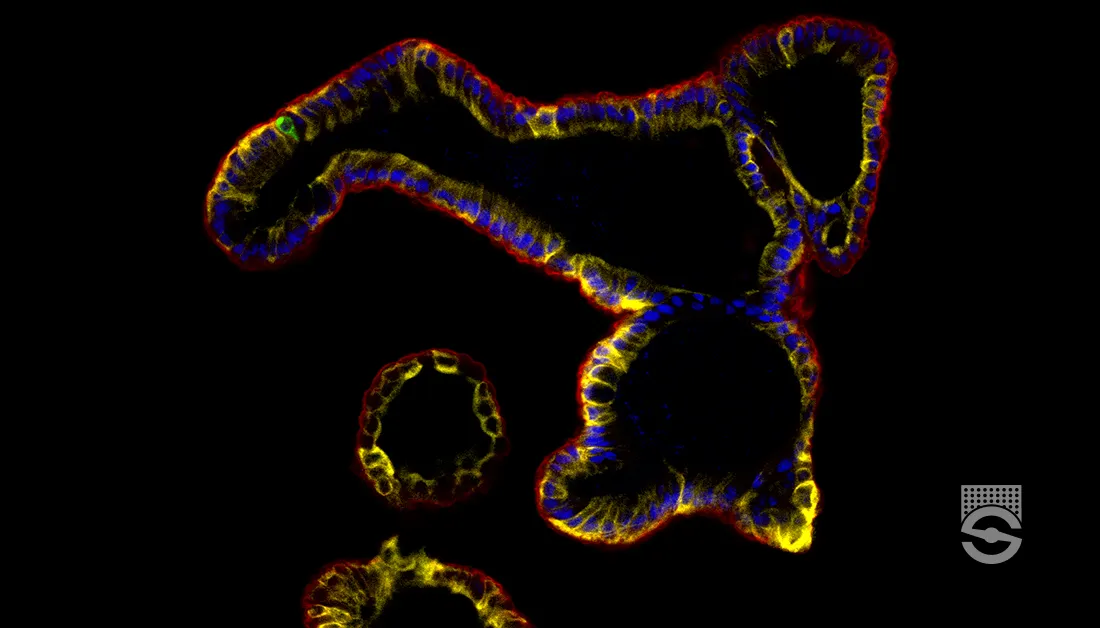
Using a BG 12 exciter filter, and OG 4 (yellow) and/or OG5 (orange) barrier filter, fungi fluoresce yellow with acriflavine and green-red with acridine orange.

Notes

  • This is most useful as a screening method.
  • If background fluorescence is too bright for fungi to be distinguished,it may be quenched with an alum hematoxylin for 1 minute,or 0.5% aqueous potassium permanganate for 1 minute.Quench immediately before the final dehydration step.This should be done with caution as it may reduce fungal fluorescence.

Safety Note

Prior to handling any chemical, consult the Safety Data Sheet (SDS) for proper handling and safety precautions.

References

No specific reference is given for this method. A similar technique using periodic acid as the oxidant is found in:

  1. Culling C.F.A., (1974)
    Handbook of histopathological and histochemical techniques Ed. 3
    Butterworth, London, UK.
Periodic Acid Fluorescent Schiff

By Aldehydes, Periodic Acid-Schiff Reaction, Protocols, Schiff's Reagent Reactions, Stain Target, Stain Type

Periodic Acid Fluorescent Schiff

9
steps
2
materials

Materials

Tissue Sample

5µ paraffin sections of neutral buffered formalin fixed tissue are suitable. Other fixatives are likely to be satisfactory.

Protocol

  1. Dewax and hydrate sections.
  2. Place in periodic acid for 10 minutes.
  3. Wash well with tap water.
  4. Rinse with distilled water.
  5. Place in fluorescent Schiff reagent for 20 minutes.
  6. Wash well with tap water.
  7. Place in acid alcohol, two changes, 5 minutes each.
  8. Wash well with tap water.
  9. Dehydrate, clear and mount in a non fluorescent resinous medium.

Expected Results

Using a BG 12 exciter filter, and OG 4 (yellow) and/or OG5 (orange) barrier filter, 1-2-glycols fluoresce yellow with acriflavine and green-red with acridine orange.

Periodic acid fluorescent schiff

Notes

  • The same materials fluoresce as would be red or pink in a regular PAS reaction.
  • If background fluorescence is too bright it may be quenched with alum hematoxylin for 1 minute,or 0.5% aqueous potassium permanganate for 1 minute. Quench immediately before the final dehydration step.This should be done with caution as it may reduce fluorescence.

Safety Note

Prior to handling any chemical, consult the Safety Data Sheet (SDS) for proper handling and safety precautions.

References

  1. Culling C.F.A., (1974)
    Handbook of histopathological and histochemical techniques Ed. 3
    Butterworth, London, UK.