Category

Dye Type

Garvey-Movat Pentachrome for Elastic, Mucin & Collagen

By Dye Type, Elastic Fibers, Iron Hematoxylin, Protocols, Stain Target, Stain Type

Garvey-Movat Pentachrome

for Elastic, Mucin & Collagen

13
steps
17
materials

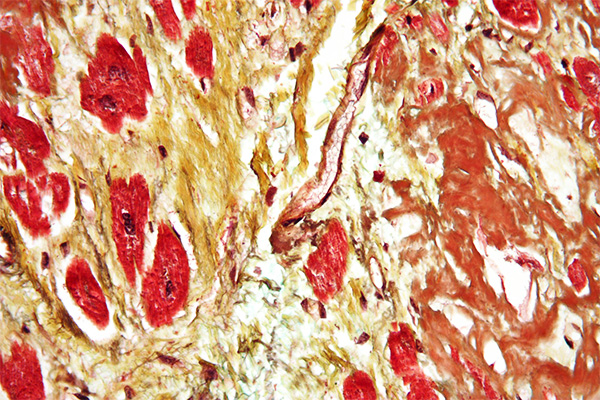
Expected Results

  • Nuclei  –  black
  • Elastic fibres  –  black
  • Fibrin – mature  –  red
  • Muscle  –  red
  • Collagen  –  yellow
  • Ground substance  –  blue-green

Materials

Stock Verhoeff A

MaterialAmount
Hematoxylin3g
Ethanol, absolute100mL

Stock Verhoeff B

MaterialAmount
Ferric chloride2.3g
Distilled water100mL

Stock Verhoeff C

MaterialAmount
Potassium iodide4g
Iodine2g
Distilled water100mL

Working Verhoeff

MaterialAmount
Stock solution A3volumes
Stock solution B2volumes
Stock solution C1volume

Polyacid

MaterialAmount
Phosphotungstic acid2g
Distilled water100mL

Acetic water

MaterialAmount
Acetic acid, glacial0.5mL
Distilled water100mL

Picro-mercuric chloride

MaterialAmount
Picric acid, sat. aqu.100mL
Mercuric chloride5g
Distilled water100mL

Alcian blue

MaterialAmount
Alcian blue1g
Acetic acid, glacial3mL
Distilled water100mL

Plasma stain

MaterialAmount
Biebrich scarlet, 1% aqu.8mL
Acid fuchsin, 1% aqu.2mL
Acetic acid, 1% aqu.100mL

Fibre stain

MaterialAmount
Saffron du Gatinais6g
Ethanol, absolute100mL

Preparation

  1. Add the saffron to the ethanol and seal the container.
  2. Incubate at 56°C for 2 weeks. This solution must be anhydrous.

Tissue Sample

Formol sublimate fixation is preferred, although 10% formalin variants are acceptable. Paraffin sections at 3µ are preferred.

Protocol

  1. Bring sections to water via xylene and ethanol.
    1. Optionally, place into picro-mercuric chloride for 1 hour.
    2. Wash well with warm water to remove picric acid.
  2. Rinse with 3% acetic acid.
  3. Place in alcian blue at 60°C for 10 minutes
  4. Rinse with distilled water.
  5. Place in working Verhoeff’s solution for 6 minutes.
  6. Wash with warm tap water for 6 minutes.
  7. Place in the plasma stain for 3 minutes
  8. Rinse with distilled water.
  9. Place in the polyacid for 15 minutes.
  10. Rinse with 1% acetic acid.
  11. Dehydrate thoroughly with absolute ethanol 3 changes.
  12. Place in the fiber stain for 5-6 minutes.
  13. Dehydrate, clear and mount with a resinous medium

Notes

  • Sections should be treated with picro-mercuric chloride if formol sublimate or similar fixation was not used initially.
  • The ferric chloride should be the hexahydrate crystals.
  • Sections thicker than 4µ may need the elastic stain differentiated by treating with 1% aqueous ferric chloride for 20-30 seconds, then washing well with tap water.
  • Although the iodine content of the Verhoeff elastic stain component may remove any mercury pigment, in methods such as this, some technologists prefer to apply the iodine-thiosulphate sequence before staining.

Safety Note

Prior to handling any chemical, consult the Safety Data Sheet (SDS) for proper handling and safety precautions.

References

  1. Garvey W., et. al., (1986),
    Improved Movat pentachrome stain
    Stain Technology, V. 61, No 1, pp 60-62.

Cole’s Alum Hematoxylin Variants

By Dye Type, Hematoxylin and Eosin Staining, Mordanted Hematoxylin, Protocols, Stain Type

Cole's Alum Hematoxylin Variants

8
steps
7
materials

References to Cole’s hematoxylin that do not specify which of the two formulae is meant, usually refer to the 1943 formula.

Materials

MaterialVariantFunction
19031943
Hematoxylin6 g1.5 gDye
Ammonium alum6 g100 gMordant
Distilled water320 mL950 mLSolvent
100% ethanol320 mL50 mLSolvent
Glycerol290 mLStabiliser
Iodine0.5 gOxidant
Glacial acetic acid75 mLSee noteAcidifier

Compounding Procedures

1903

  1. Dissolve the alum in water.
  2. Dissolve the hematoxylin in ethanol.
  3. Combine, then add the other ingredients and mix well.
  4. The solution must ripen before use.

1943

  1. Dissolve the hematoxylin in 250 mL water with heat.
  2. Dissolve the alum in 700 mL water.
  3. Dissolve the iodine in the ethanol.
  4. Combine the dye and iodine solutions.
  5. Add the alum solution.
  6. Bring to a boil.
  7. Cool and filter.
  8. The solution may be used immediately.

Protocol

  1. Bring sections to water with xylene and ethanol.
  2. Place into the staining solution for an appropriate time.
  3. Rinse well with water.
  4. Differentiate with acid ethanol if necessary.
  5. Rinse with water and blue.
  6. Rinse well with water.
  7. Counterstain if desired.
  8. Dehydrate with ethanol, clear with xylene and mount with a resinous medium.

Expected Results

  • Nuclei  –  blue
  • Background  –  as counterstain or unstained

Notes

  • The original 1943 formula contains no added acid. Used progressively, and applied for 5-10 minutes, it gives results similar to those obtained with a differentiated regressive formula.
  • The addition of 20 mL glacial acetic acid to the 1943 formula increases nuclear selectivity and extends the working life of the solution. This is often used for progressive nuclear counterstaining and in the celestine blue-hemalum sequence.
  • The staining time for the 1903 formula should be determined by trial.
  • Acid ethanol is 0.5% – 1% hydrochloric acid in 70% ethanol.
  • Blueing is done with alkaline solutions such as hard tap water, Scott’s tap water substitute, 0.1% ammonia water, 1% aqueous sodium acetate, 0.5% aqueous lithium carbonate etc.

Safety Note

Prior to handling any chemical, consult the Safety Data Sheet (SDS) for proper handling and safety precautions.

References

  1. Culling, C.F.A., Allison, R.T. and Barr, W.T.
    Cellular Pathology Technique, Ed.4.
    Butterworth, London, UK.
  2. Drury, R.A.B. and Wallington, E.A., (1980)
    Carleton’s histological technique Ed. 5
    Oxford University Press, Oxford, UK.
  3. Bancroft, J.D. and Stevens A. (1982)
    Theory and practice of histological techniques Ed. 2
    Churchill Livingstone, Edinburgh & London, UK.
  4. Gray, Peter. (1954)
    The Microtomist’s Formulary and Guide.
    Originally published by: The Blakiston Co.
    Republished by: Robert E. Krieger Publishing Co.

Herovici’s Stain for Young and Mature Collagen

By Dye Type, Picro-Fuchsin, Protocols, Stain Type, Trichrome Staining

Herovici's Stain

for Young and Mature Collagen

7
steps
7
materials

Materials

Tissue Sample

Paraffin sections at 5µ of formol-acetic-ethanol (10:5:85) fixed tissue was recommended.

Protocol

  1. Bring sections to water via xylene and ethanol.
  2. Stain nuclei with the acid resistant nuclear stain.
  3. Rinse well with tap water.
  4. Place into the staining solution for 2 minutes.
  5. Wash with 1% acetic acid for 2 minutes.
  6. Dehydrate with ethanol.
  7. Clear with xylene and mount with a resinous medium.

Expected Results

  • Young collagen and reticulin – blue
  • Mature collagen – red
  • Cytoplasm – yellow
  • Nuclei – black

Notes

  • Solution A is van Gieson’s solution.
  • Cook notes that the original included a final step with metanil yellow for cytoplasmic staining, which he omitted.

Safety Note

Prior to handling any chemical, consult the Safety Data Sheet (SDS) for proper handling and safety precautions.

References

  1. Cook, H. C., (1974)
    Manual of Histological Demonstration Techniques
    Butterworths, London, UK.
    Citing:
    Herovici, c., (1963)
    Stain Technology, v. 38, p. 204

Puchtler’s Picro-Sirius red for Collagen

By Dye Type, Picro-Fuchsin, Protocols, Stain Type, Trichrome Staining

Puchtler's Picro-Sirius red

for Collagen

6
steps
4
materials

Materials

Picro-sirius red

MaterialAmount
Sirius red F3B0.5g
Saturated aqueous picric acid500mL

Acetic acid water

MaterialAmount
Acetic acid, glacial5mL
Distilled water11mL

Tissue Sample

5µ paraffin sections of neutral buffered formalin fixed tissue are suitable.

Protocol

  1. Bring sections to water.
  2. Optionally, stain nuclei with an acid resistant nuclear stain.
  3. Wash well with water.
  4. Place into Picro-sirius red solution for 1 hour.
  5. Wash with two changes of acetic acid water.
  6. Dehydrate with ethanol, clear with xylene and mount with a resinous medium.

Expected Results

Light Microscopy

  • Nuclei – black if stained
  • Collagen – red
  • Cytoplasm – yellow

Polarising Microscopy

  • Large fibres – yellow or orange birefringence
  • Thin fibres – green birefringence

Notes

  • This method can be used as an alternative for van Gieson’s stain or, using polarising microscopy, as a sensitive method for collagen.

Safety Note

Prior to handling any chemical, consult the Safety Data Sheet (SDS) for proper handling and safety precautions.

References

  1. Kiernan. J.A., (1999)
    Histological and histochemical methods: Theory and practice, Ed. 3
    Butterworth Heinemann, Oxford, UK.

van Gieson’s Stain for Collagen

By Dye Type, Picro-Fuchsin, Protocols, Stain Type, Trichrome Staining

van Gieson's Stain

for Collagen

7
steps
3
materials

Materials

Tissue Sample

Paraffin sections at 5µ are suitable. Many fixatives, including formalin, are satisfactory. Stains using acid dyes often benefit from picric acid or mercuric chloride fixation.

Protocol

  1. Bring sections to water via xylene and ethanol.
  2. Stain nuclei with the acid resistant nuclear stain.
  3. Rinse well with tap water.
  4. Place into the staining solution for 2-5 minutes.
  5. Optionally, rinse quickly with distilled water.
  6. Dehydrate with ethanol.
  7. Clear with xylene and mount with a resinous medium.

Expected Results

  • Collagen – red
  • Cytoplasm – yellow
  • Nuclei – black

Notes

  • This method is often used to counterstain other primary staining methods. In that case the nuclear stain may not be necessary and should be ommitted.

Safety Note

Prior to handling any chemical, consult the Safety Data Sheet (SDS) for proper handling and safety precautions.

References

  1. Gray, Peter. (1954)
    The Microtomist’s Formulary and Guide.
    Originally published by: The Blakiston Co.
    Republished by: Robert E. Krieger Publishing Co.
  2. Drury, R.A.B. and Wallington, E.A., (1980)
    Carleton’s histological technique Ed. 5
    Oxford University Press, Oxford, UK.
  3. Culling C.F.A., (1974)
    Handbook of histopathological and histochemical techniques Ed. 3
    Butterworth, London, UK.

Kohashi’s Trichrome for Elastic and Collagen

By Dye Type, Elastic Fibers, Orcein, Protocols, Stain Target, Stain Type, Trichrome Staining, Trichrome, Multi-Step

Kohashi's Trichrome

for Elastic and Collagen

12
steps
14
materials

Materials

Solution A

MaterialAmount
Azocarmine0.1g
Acetic acid, glacial1mL
Distilled water99mL

Solution B

MaterialAmount
Aniline0.1mL
Ethanol, 95%100mL

Solution C

MaterialAmount
Acetic acid, glacial1mL
Ethanol, 95%100mL

Solution D

MaterialAmount
Phosphotungstic acid5g
Distilled water100mL

Solution E

MaterialAmount
Eosin B0.7g
Acid fuchsin, sat. aqu.4mL
Unna’s elastic stain35mL
Ethanol, 50%35mL
Glycerol40mL

Tissue Sample

Many fixatives are satisfactory. 5µ paraffin sections of neutral buffered formalin fixed tissue are suitable. Most trichrome stains benefit from picric acid or mercuric chloride fixation. Formalin fixed tissues may benefit from secondary fixation of sections in Bouin’s fluid.

Protocol

  1. Bring sections to water via xylene and ethanol.
  2. Place into solution A for 12-15 minutes.
  3. Rinse quickly with distilled water.
  4. Differentiate nuclei with solution B.
  5. Place into solution C for 30-60 seconds.
  6. Rinse with distilled water.
  7. Place into solution D for 30-60 minutes.
  8. Rinse with distilled water.
  9. Place into solution E for 15-20 minutes.
  10. Place into 95% ethanol until differentiated.
  11. Dehydrate with ethanol.
  12. Clear with xylene and mount with a resinous medium.

Expected Results

  • Nuclei  –  red
  • Erythrocytes  –  orange
  • Elastic fibres  –  purple
  • Cytoplasm  –  red
  • Collagen  –  blue

Notes

Safety Note

Prior to handling any chemical, consult the Safety Data Sheet (SDS) for proper handling and safety precautions.

References

  1. Gray, Peter. (1954)
    The Microtomist’s Formulary and Guide.
    Originally published by: The Blakiston Co.
    Republished by: Robert E. Krieger Publishing Co.
    Citing:
    Kohashi, (1937)
    Folia anatomica Japonica, v.15, pp.175

Mollier’s trichrome for Elastic and Collagen

By Dye Type, Elastic Fibers, Orcein, Protocols, Stain Target, Stain Type, Trichrome Staining, Trichrome, Multi-Step

Mollier's trichrome

for Elastic and Collagen

13
steps
13
materials

Materials

  • Weigert’s iron hematoxylin or equivalent
  • Solution A
    MaterialAmount
    Orcein0.8g
    Hydrochloric acid1mL
    Ethanol, 100%50mL
    Distilled water50mL
  • Solution B
    MaterialAmount
    Azocarmine2g
    Acetic acid, glacial1mL
    Distilled water100mL
  • Solution C
    MaterialAmount
    Phosphotungstic acid5g
    Distilled water100mL
  • Solution D
    MaterialAmount
    Naphthol green B1g
    Acetic acid, glacial1mL
    Distilled water100mL

Tissue Sample

5µ paraffin sections of neutral buffered formalin fixed tissue are suitable. Other fixatives are likely to be satisfactory. Most trichrome stains benefit from picric acid or mercuric chloride fixation. Formalin fixed tissues may benefit from secondary fixation of sections in Bouin’s fluid.

Protocol

  1. Bring sections to water via xylene and ethanol.
  2. Place into solution A for 12 hours.
  3. Stain nuclei with Weigert’s iron hematoxylin for 1-3 minutes.
  4. Differentiate the nuclear stain if necessary.
  5. Wash with water for 15 minutes.
  6. Place into solution B for 15-30 minutes.
  7. Rinse with distilled water.
  8. decolorise in solution C for 2-6 hours, changing the solution three times.
  9. Rinse quickly with distilled water.
  10. Place into solution D for 15-30 minutes.
  11. Agitate vigorously in 95% ethanol for 30 seconds.
  12. Dehydrate with ethanol.
  13. Clear with xylene and mount with a resinous medium.

Expected Results

  • Nuclei  –  blue
  • Elastic  –  black
  • Erythrocytes  –  red
  • Cytoplasm  –  purple
  • Collagen  –  green

Notes

  • Solution A is the Unna-Taenzer elastic solution.

Safety Note

Prior to handling any chemical, consult the Safety Data Sheet (SDS) for proper handling and safety precautions.

References

  1. Gray, Peter. (1954)
    The Microtomist’s Formulary and Guide.
    Originally published by: The Blakiston Co.
    Republished by: Robert E. Krieger Publishing Co.
    Citing:
    Mollier, (1938)
    Zeitschrift für wissenschaftliche Mikroskopie und für mikroskopische Technik, v.55, pp.472.
    And:
    von Kahlden, C. and Laurent, O., (1896)
    Technique microscopique, pp.143
    Carré, Paris, France

Bennett’s Alum Hematoxylin

By Dye Type, Hematoxylin and Eosin Staining, Mordanted Hematoxylin, Protocols, Stain Type

Bennett's Alum Hematoxylin

6
steps
6
materials

Materials

MaterialAmountFunction
Hematoxylin1 gDye
Potassium alum90 gMordant
Distilled water1 LSolvent
Sodium iodate0.2 gOxidant
Chloral hydrate50 gStabiliser
Citric acid1 gAcidifier

Compounding procedure

  1. Heat the water. Then add in order:
    1. Hematoxylin
    2. Sodium iodate
    3. Alum
    4. Citric acid
    5. Chloral hydrate.

    Note: Dissolve each ingredient before adding the next.

  2. Cool to room temperature and filter. It may be used immediately.

Protocol

  1. Bring sections to water with xylene and ethanol.
  2. Place into the staining solution for 5-20 minutes.
  3. Rinse with water and blue.
  4. Rinse well with water.
  5. Counterstain if desired.
  6. Dehydrate with ethanol, clear with xylene and mount with a resinous medium.

Expected Results

  • Nuclei  –  blue
  • Background  –  as counterstain or unstained

Notes

  • Putt gives no information regarding staining time and characteristics, but the similarity of the formula to Mayer’s (Langeron’s) hemalum suggests it is progressive and selectively nuclear. A staining time of 10-20 minutes should be adequate.
  • Blueing is done with alkaline solutions such as hard tap water, Scott’s tap water substitute, 0.1% ammonia water, 1% aqueous sodium acetate, 0.5% aqueous lithium carbonate etc.

Safety Note

Prior to handling any chemical, consult the Safety Data Sheet (SDS) for proper handling and safety precautions.

References

  1. F. A. Putt
    Manual of Histopathological Staining Methods
    John Wiley & Sons, New York, NY., USA

Bencosme’s Alum Hematein

By Dye Type, Hematoxylin and Eosin Staining, Mordanted Hematoxylin, Protocols, Stain Type

Bencosme's Alum Hematein

8
steps
8
materials

Materials

Original

MaterialAmountFunction
Hematein2 gDye
Potassium alum133 gMordant
Distilled water920 mLSolvent
Glacial acetic acid20 mLAcidifier

Variant

MaterialAmountFunction
Hematein2.5 gDye
Potassium alum120 gMordant
Distilled water1 LSolvent
Glacial acetic acid10 mLAcidifier

Compounding procedure

  1. Add the alum to the water in a 2 L flask and bring to a boil for 1 minute.
  2. Add the hematein and mix by swirling.
  3. Place an inverted funnel over the flask and simmer for 10 minutes, shaking frequently.
  4. Cool to room temperature and add the acetic acid.
  5. Filter before use and twice weekly.
  6. It may be used immediately.

Protocol

  1. Bring sections to water with xylene and ethanol.
  2. Place into the staining solution for 2 minutes.
  3. Rinse with water.
  4. Differentiate with 0.5% hydrochloric acid in 70% ethanol for one second.
  5. Rinse well with water and blue.
  6. Rinse well with water.
  7. Counterstain with HPS.
  8. Dehydrate with ethanol, clear with xylene and mount with a resinous medium.

Expected Results

  • Nuclei  –  blue
  • Background  –  shades of red and yellow.

Notes

  • Note that this solution uses hematein rather than hematoxylin. Hematoxylin could be used, but would require 0.4 grams sodium iodate to be added along with the dye for complete oxidation in the original solution, although 0.3 grams might be more appropriate to extend the life. Comparable amounts would be 0.5 g and 0.4 g, respectively, for the variant formula.
  • When freshly made this solution stains in 2 minutes. Staining time slowly increases to 10 minutes as the solution ages. Life is about a month.
  • Blueing is done with alkaline solutions such as hard tap water, Scott’s tap water substitute, 0.1% ammonia water, 1% aqueous sodium acetate, 0.5% aqueous lithium carbonate etc.

Safety Note

Prior to handling any chemical, consult the Safety Data Sheet (SDS) for proper handling and safety precautions.

References

  1. Medical Laboratory Technology, 2nd ed. (1969)
    Lynch M.J., Raphael S.S., Mellor L.D., Spare P.D. and Inwood M.J.H.,
    W. B. Saunders Co., Toronto, On., Canada

Bensley’s Copper Hematoxylin

By Dye Type, Hematoxylin and Eosin Staining, Mordanted Hematoxylin, Protocols, Stain Type

Bensley's Copper Hematoxylin

10
steps
8
materials

Materials

Solution A

MaterialAmountFunction
Hematoxylin,1 gDye
Distilled water100 mLSolvent

Solution B

MaterialAmountFunction
Cupric acetate,to saturationMordant
Distilled water100 mLSolvent

Solution C

MaterialAmountFunction
Potassium chromate,5 g
Distilled water100 mLSolvent

Solution D

MaterialAmountFunction
Weigert’s borax-ferricyanide20 mLDifferentiator
Distilled water80 mLDiluent

Compounding procedure

Make each solution separately.

Protocol

  1. Bring sections to water with xylene and ethanol.
  2. Place into solution A for 5 minutes.
  3. Rinse with water.
  4. Dip into solution B.
  5. Rinse with water.
  6. Place into solution C for 2 minutes.
  7. Return to solution A for 1 minute.
  8. Place in solution D until differentiated.
  9. Rinse well with water.
  10. Dehydrate with ethanol, clear with xylene and mount with a resinous medium.

Expected Results

  • Nuclei and other structures  –  blue-black

Notes

  • After step 7, the sections should be intense black. Repeat steps 5-7 if necessary.
  • Bensley recommended prestaining with Mayers mucicarmine.
  • Best results are obtained with freshly made solutions

Safety Note

Prior to handling any chemical, consult the Safety Data Sheet (SDS) for proper handling and safety precautions.

References

  1. Bensley R. R. and Bensley, S. H., (1938)
    Handbook of Histological and Cytological Technique.
    U. Chicago Press, Chicago, USA